The best way I can describe reading K-Ming Chang’s work is as being poured upon by language. I was thinking about this as I read her latest novel, Needlemouth, out October 20th from Simon & Schuster. In the past, I’ve dove into Chang’s writing wanting to digest it, word by word—to understand everything. In contrast, reading Needlemouth is like being inside a hurricane: careening, lurching, leaning into vertigo. It asks to be consumed in a single, enormous gulp.
Told through the alternating perspectives of the titular Needlemouth, a demon, and three cousins: Cindy, Yangyang, and Mandy, Chang’s latest is an otherworldly dream of a nightmare, a coming-of-age horror story, a Gothic haunting, a battle cry against patriarchy.
Chang last spoke to Four Way Review about the craft of her writing (and much more) in 2021, and we’re thrilled to feature her again.
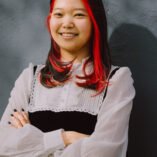
K-Ming Chang is interviewed by E Ce Miller and Moby Yang.
Four Way Review (FWR): Needlemouth is psychedelically surreal, really lyrical, and image-driven, like so much of your other writing. Where did Needlemouth begin: an image, a sentence, a character, a theme?
K-Ming Chang (KMC): In some ways, [writing Needlemouth] was a terrifyingly new experience; in others, it aligned with my past work. I am a very language-driven writer. I tend to think of language first before ideas. In the case of Needlemouth, ironically, Needlemouth [the character] was always in the background; always sort of lurking.
There were many different entry points into this manuscript. In the foreground were the [cousins]. I began with them, and Needlemouth was not in the narrative. But there were many surreal aspects: a whale’s tongue growing in their backyard, supernatural occurrences in their grandma’s house. There was this ancestral voice happening. [In one draft of Needlemouth] there was a landline telephone, and the cord was an umbilical cord–this ancestral landline that connected them to their mothers. Needlemouth was always skirting my vision. I was writing with a real sense of urgency, but not sure where that urgency was coming from, and I think when Needlemouth arrived on the page, both for me as a writer and then literally by [the cousins’] bedside, I felt the momentum begin to pick up.
The eye of the storm [of this novel] became Needlemouth the demon, and once all [the supernatural] elements coalesced around her, I could let her speak. It was such a liberating feeling to let this monster—who in my mind is the hero—finally unleash on the page. It was such intense relief. It pushed me into a faster-paced process than I’m used to, and it also shaped the book narratively. I think Needlemouth just stole the manuscript from me, which was a great feeling.
FWR: Thinking about that image of the whale’s tongue, certain motifs, things like mouths, teeth, birds, feathers, blood, recur across all of your books. Has your relationship to some of these elements evolved over the course of your books? What still fascinates you about them?
KMC: I’m so obsessed with teeth. Teeth are my number one. I love the idea of evolving obsessions. I think it’s wonderful to be encouraged to write toward your obsessions. I listened to this interview with the poet Natalie Diaz, and she was encouraging writers [to steer] toward their obsessions, to keep returning [to them]. What I love so much about her work is that she’s constantly transforming images.
I’m really interested in the depth of language and image, and how you can continually look at something, flip it, flip it, flip it, and it can constantly transform. The number one edit that I always get is: you have six metaphors for the same thing, you have six similes in one sentence. It’s always a little heartbreaking for me, because I want all six similes describing one tooth. I can’t choose.
I like pathways on the page; I like the maximalism. I like that these things compete with each other. I want these images to be bouquets of language that present many possibilities, and the reader can choose how they want to process [them]. Keep the six: overwhelm, overwhelm. I love the sense of disorientation of an image that’s continually transforming and never quite lands on exactly what it is.
FWR: What is your editing process like when you’re asked to narrow six similes down to one? What informs your linguistic choices?
KMC: With Needlemouth, I worked closely with my brilliant editor, Brittany Adames. It was unusual in a beautiful, exciting way because the book was sold as a partial manuscript, so I had this possible, undulating, strange other half of the story… to get to build with someone else. My editorial process tends to be quite intensive because I don’t gravitate toward narrative naturally. Structure and big-picture things, which are so foundational, are always the [hardest] for me to figure out. This time it was really collaborative. A huge part of it was just how well she understood the work and the sense of playfulness with which she approached the text. It was a very liberating process. It was so freeing. She really allowed me to play and explore.
“There is nothing more terrifying to me than the omission of detail.”
– Needlemouth, K-Ming Chang
Rather than whittling it down, [the manuscript] was constantly opening back up. As a writer, I avoid making decisions. Instead, I try to take a decision and flip it on its head. [If] two elements are competing, or I’m not sure what to do with language, or I don’t know if [something] belongs, I’ll find a new way to reframe that question, rather than make a decision. People [say] “kill your darlings.” I’ve never been able to do that. I think: what if I made this a game for myself? What if I moved this to a different place? What if I put this in a new project? What if I looked at the blank page and rearranged these elements? What are ways to make this feel playful and fun and exciting?
FWR: You have described your books Bestiary, Gods of Want, and Organ Meats as a “mythic triptych” and a “fecal trio”. I can’t help but see a connection to the trio of cousins tying together the narration of Needlemouth. Is there something that draws you to groups of three?
KMC: I’m really interested in the mythological element [of threes.] The asymmetry of an odd number is fascinating to me structurally. There’s a temporal element of: past, present, future. Different generations. I’m interested in smearing the boundaries between those things, subverting expectations of time by playing with more circular narrative structures.
With the cousins [in Needlemouth], I see them almost as one figure. They are three different [characters], literally, in the narrative, but elements of each of them hinged on, and were in direct conversation with, the others. I feel like they represent three forms of life coping with tragedy, with patriarchal control. The three of them are at three different stages of defeat and grief, but then they’re also coexisting together, really different, but also the same. Facet is a good word, because it’s like they’re reflecting off of each other, refracting each other in different ways.
“We would lie in our bed and pretend to be our mothers, three sisters lashed together. We would call each other by our mothers’ names, stargaze at the leaks in the ceiling and drip from their lineages. Because we could not imagine freedom ahead of them, our only hope was to imagine that it lay behind them. They could go backward into being. If there was no future, there must have been a past.”
– Needlemouth, K-Ming Chang
FWR: There is a resonant moment when Needlemouth hijacks one of Cindy’s chapters to give her “First and Final Testimony”, which spans almost a quarter of the novel. I’m curious about Needlemouth’s space in this narrative, seeing as this hijacking is where her voice is first integrated into the book—existing as a narration inside a narration, a voice inside a voice.
KMC: There was a question of whether to spread out the narrative through the book. But [I felt it] had to be this undigestible hunk of meat, this painful carcass deposited into the book. I really wanted the reader to be very immersed in it. So it didn’t make sense to me to break it into more digestible vignettes. I felt very strongly about the sheer number of pages and also the depth of that section. Her voice was so immediate and didn’t change very much through all the stages of the book. I wanted it to have a certain clarity and assertiveness.
I wanted [Needlemouth] to be so frustrated. She’s this spiritually constipated monster. She’s waiting to speak. She needs to assert herself. She feels a need to defend her own existence. To me, there was something really tragic about that.
In an ideal world, I don’t think [Needlemouth] would need to speak. I don’t think she would even need to frame her story, but she’s at this tribunal, before a jury…
I wanted it to be this moment of finally unleashing and unburdening herself, but also for it to be this deeply painful process, for her to feel like she’s been forced to speak. She’s freeing herself, but never entirely free, which I think is the tragedy of that character.
FWR: Mothers, daughters, and grandmothers occupy a central place in much of your work. In Needlemouth, I wanted to ask you about two things regarding matrilineage. One is the function of the erotic in matrilineage—I’m thinking about the line where Cindy implores Needlemouth to beg Cindy to adopt her, before describing this moment of surrender to Needlemouth’s mouth on her neck. Then, later, in one of the stories/warnings Needlemouth offers, there is the line, “Perhaps in my past life, my mother was my daughter…” I’m curious, just generally, how you think of the term “matrilineage” given that these matriarchal relationships in your books are not necessarily linear and also allow for the erotic
KMC: I was very much thinking about subverting the hierarchical relationships among women between these generations. I wanted it to be a strange riddle for Needlemouth to say “adopt me as one of your mothers.” I purposely wanted that to be a bit strange, a bit of a puzzle of language.
What would it mean to adopt an ancestor? What would it mean to adopt a mother or a grandmother?
To me, Needlemouth is a figure of intervention, and that’s what I love so much about the supernatural: [it] can disrupt and interrupt. She’s purposely coming in and destroying these lineages, snipping, and editing and inserting herself. She has this logic-defying, time-defying, chaotic desire. And for her, it’s possible. She doesn’t feel constrained. What do you mean you can’t go back in time? What do you mean you cannot adopt me as your mother? She is unlimited and unbound in her ferocious hunger and desire.
In terms of intergenerational relationships between women, I think this book is about replicating violence and enabling violence. The women in this book are the mothers and grandmothers and the women who often have power over the children in their lives: enabling abusers, or self-perpetuating abuse, or raising girls in a way that accepts abuse and normalizes it. Part of that is making meaningful their own suffering. I think the idea of meaningful suffering is very present throughout the novel, with the mothers and the aunts insisting that this pain is meaningful; this pain is what makes us good, to suffer is noble.
This patriarchal myth that oftentimes is perpetuated by women to other women: [your pain] is for the good of the world, for the good of this family. That’s why I think Needlemouth as this ancient, but also young, mother and daughter; a figure of chaos, a hurricane-like figure who can come in and disrupt these hierarchies and these cycles.
FWR: One of my favorite movies is I Saw the TV Glow, and I couldn’t help but recognize some of the magic of that film in Needlemouth. This novel is so visceral, and yet, there is the TV in the mix. In the history of television in the U.S., having a TV is, I think, one of the key aspects of the home—a way to step into the outside world without ever leaving the domestic space, a way to see other people, alternate dimensions, without ever stepping out of yourself. There is a moment where Cindy says, “All glass is a portal.” How did you see the TV—and perhaps other glass, like the mirror, the window—functioning in this story which is so bound to the physically and temporally isolated interior of the home?
KMC: One of the moments that came in later in the edits is the scene where the aunts entered the soap opera—the TV narrative. Again, so much of the book is about cycles and the different ways that we absorb narratives and how that can feed into perpetuating certain stories about what it means to be a good daughter, what it means to be a good mother, what it means to be self-sacrificing, what it means to devalue your own pain and your own rage for a regularly functioning patriarchal world. I wanted the soap opera to be a mirror into their family life—for them to be ensnared, a mirror held up to a mirror just infinitely reflect[ing] the same image. They’re just mirrors bouncing off each other, the same image repeated infinitely. Even as these mirrors are a portal, they only show you what you can show them. There’s this feeling of being trapped. I was thinking, what are the ways out [for these girls]?
“That night, I crawled out from behind the TV and visited you in your bed, looming over you and stroking your face with my shadow, flipping up the hem of your shirt for some evidence that you had not been born from a human but from the mirror.”
– Needlemouth, K-Ming Chang
[The scene when] Cindy [is unable] to recognize himself in the mirror is an interesting departure. People talk about the mirror test: what animals can recognize themselves in the mirror? I feel like that’s a very human baseline of intelligence. We’re obsessed with the idea that to possess intelligence is to be able to recognize yourself in the mirror. Cindy doesn’t recognize herself in the mirror, so what does that mean for her? Maybe in not recognizing yourself, there’s opportunity to become something else.
FWR: I wanted to ask about the sections of Needlemouth told through Mandy’s diary entries. Mandy’s voice in her diary is very pragmatic, realist at times. Readers witness surreal exchanges between Cindy and Needlemouth, and then turn the page and are thrust into Mandy’s voice explaining, very plainly, “The demon has Cindy…I don’t know what to do.” We even get asides like: “(I would really love a pickle right now. Sour things help me deal with stress.)” What made you want to write Mandy as a series of diary entries?
KMC: I love any epistolary form. I also think it’s very prominently used in horror. There’s something about found narrative, found footage, found ephemera that I find really conducive to this genre. I also really love stories about storytelling: how the story is told, who gets to tell it, and why.
I think on a more narrative level, Mandy made me very sad. Her veneer of humor and meanness is what I love about her. She has this boldness and desire to act. She can be really mean sometimes, which I really admire about her. Beneath that, there’s a tragedy where she [tell’s herself she’s] worthless. The more funny and performative she is on the surface, the more the layers of tragedy feel like they’re in greater contrast.
Mandy thinks of herself as the fighter, compared to her cousins. But deep down, she’s also the most defeated, the most deeply accepting of her lot in life, compared to the other two cousins. I think those layers of high contrast really come through in the diary because she is speaking to herself. But I think there’s a layer of performance in the diary entries that lets her pull off this kind of high-wire act, because she [knows her cousin is probably going to steal and read her diary.]
FWR: You mentioned humor and playfulness. Much has been said about the surrealness of your writing, the way it challenges and disrupts and disorients readers, but there are these moments of unexpected humor, too. One example I can think of, where I literally laughed out loud, comes during an exchange between Yangyang and Mandy, when Yangyang says, “Patricide can’t be that bad. We have patricide in the garage.” And Mandy replies, “That’s pesticide, you idiot.” How do you think about humor in your writing?
KMC: I’m so glad you highlighted that moment. That brings me pure delight and joy as a writer. This is why I write: so someone will laugh at my patricide pesticide joke. What do I want readers to take away from the reading experience? Enjoy that moment of accidental punning, this little joke.
I once read that humor and horror share the same premise, which is transgression. What we find funny and what we find horrifying [are things] that transgress… These are really similar feelings, and the boundaries between them are something I’m interested in disrupting or erasing a little bit.
FWR: In an interview with Electric Lit, you spoke about a class you took with Jenny Zhang and how the Western coming-of-age story typically follows a character “throwing off the shackles of [their] family.” I am interested in what you said about “want[ing] to tunnel backward and burrow into the family as a form of queer coming of age.” I’m wondering if you could talk a little bit more about this?
KMC: Each of the girls [in Needlemouth] is so lonely in their own ways. [I wanted to] move them toward a true collective and harness their desire to be free, to let them save one another, [in order] to save themselves, which is maybe the most important thing of all. There’s this journey of becoming an individual, a sense of [these girls] going out and taking over the world, but hopefully they do it with each other and find other isolated girls in similar situations.
FWR: Earlier, we talked about this umbilical connection to ancestry, which I thought was really interesting. In Needlemouth, the line between life and death is blurred. What interests you about this examination of liminal space?
KMC: I often conceive of my characters as thresholds or gateways between different worlds, between the living and the dead. Part of this is my inheriting a lot of mythology, and the desire to transform that. I think of these girls as almost vulture-like creatures.
There’s something very vulture-like about being a writer. We’re just eating dead things, picking through bones and tendons, looking for roadkill, harvesting these carcasses in order to digest and metabolize them into life. At least that’s how I feel.
I think of these characters as grazing on the dead in that way. They’re so deeply connected to the stories that have formed them, becom[ing] like a groove of mythology. Part of their journey is deciding: what will I do with what I’ve inherited? Will I pass it on? Will I transform it? Will I destroy it within myself? Will I incinerate it?
On a more literal level, I am interested in narrative as a form of visitation. I’m always thinking about who can visit. Sometimes it is a very literal spirit, a ghost, or some ghostly fragment. I like the idea that we as writers are the ones being visited. We play host to these various visitations, and sometimes what arrives is terrible and it’s nothing, and sometimes what arrives is so surprising and exciting and life-sustaining. I think that’s the real joy: being open for visitation, or maybe going out and visiting yourself, knocking on a door and seeing what answers.