
A brief translator’s note
Akazome Emon’s waka poetry anthology has been passed down through the generations. She was born around the late 950s CE, and had superstar friends: Sei Shōnagon (as a national treasure essayist, The Pillow Book) and Murasaki Shikibu (as a best-selling author, The Tale of Genji). In this short collection, I introduce four poems from her anthology. The original manuscript is hard to understand because many footnotes and historical backgrounds are needed to support her poems. She compiled a lot of information into a short waka poetry format (5-7-5-7-7 Japanese syllables). Therefore, I expanded the idea of Kotobagaki as a first-person narrative fictional prose to help readers understand her biographical and historical background. (Kotobagaki may be one line or a short paragraph in general, depending on the editor’s choice.) Through reading Akazome’s anthology, I found that she might obsessively read Nukata no Ōkimi’s poems (630-690 CE). I developed the idea and adapted it into a first-person narrative journaling style. This is an excerpt from my ongoing manuscript. The original text was included, and they are part of the public domain.
AUGUST,
The Twelfth Moon
Words build a line. The line makes a lyric. Some rise into a poem, and others remain here in my pages. Time is branched out yet entangled within this journal. Written words. I want them to transpire from mouths that belonged to someone—I make a gentle correction myself—it should not be plural. One mouth of a particular person is enough, isn’t it? Dearest Murasaki eclipses a poem transpiring from the mouths—plural—for the next full moon. Does my word weave with other future words? Yellow, purple, and pale pink petals withered in between Man’yōshū. I left the book inside today. The backyard bamboo forest fills me with thoughts. Its tunnel was like the parturient canal where the baby echoed before its first roar. Letters rooted off like groundwater, but I do not let my ink flow in these bamboo curves; how I capture them, instead I list seven autumn flowers; hagi-lespedeza, nadeshiko-dianthus, kudzu-lobata, omienashi-patrinia, fujibakama-bonesets, and kikyo-platycodon.
Autumn, when I visited Hōrin-ji Temple, I saw flowers around a field in Sagano.
Flowers on the field in fall
as many as I could find
my heart flutters
my heart pauses
The Eighteenth Moon
It is marvelous to visit the temple in autumn. I am staying in a small house at the end of a narrow street, as if an elliptic leaf stretched toward the internode of a bamboo stalk. It rustles all day. The worm-eaten sliding doors might need to be replaced, but the floors gleam like an eternal copper vase, collecting all sunbeams from the deck. Though only hagi intertwined alongside these stepping stones. Magenta dots popped on tiny leaves and moss. Summer was still bleeding out. I kept climbing the stone steps. It was still humid this morning, but now the cool breath rattled the candle lights. I avoided walking in muddy puddles. The green bulbs swayed. Sasanqua-camellias would soon bloom.
The next morning, about to leave, the fog swells, Higurashi-cicadas echo in the void.
Fill the sky,
a spate of mist falling
kanakanakana—cicadas blare
around the Ogura Mountain
Tamemoto might like fall—more like he was autumn before winter—unlike most others who may choose lively spring. Do I personally like autumn—I am unsure, but he might.
SEPTEMBER,
The Second Moon
“How unusual is it to start an anthology with autumn poems?” Dearest Murasaki asked.
“I heard that you are making your own poetry anthology,” she continued. Her thumb slid her folding fan open, which then slightly ruffled the air. The scent of fresh-cut mums glided. The tight green bulbs had already started blooming. Only a few days ago, my hem glided on hagi. “An opening poem; perhaps, a spring theme is common?” I could not answer it, looking into her eyes burnishing like two crescent moons gliding on the edge of her fan. She seemed to say, Aren’t you trying to be as witty as Nukata no Ōkimi? No matter how I explain, my words will spread by her. Some will agree, others will judge harshly. Besides, it is hard to pick one over another when both seasons are equally loved; I am not as clever as Nukata no Ōkimi, who wrote this poem about the seasons. Dearest Murasaki closed the fan and slowly stood up, saying, “Princess Shōshi and her mother will come shortly. Shall we prepare?” She moved her chin to tell me to follow her.
After a winter nook ends when spring comes
fidgeting birds chirp
tight bulbs bloom once more
meadows continue to hills
long grasses overgrow
it is hateful— I cannot reach toward the leaf
an autumn leaf falls on my hand
those fiery yellow leaves
but green ones—those are pitiful
autumn indeed
my favorite mountain.
— Nukata no Ōkimi (額田王) Man’yōshū, No.1 – 16
OCTOBER,
The Third Moon
Sometimes, I think that my sister was dumb. Was she in love, or was she eager to be a wife of higher status, or both? I could not stand seeing her crying by the sliding door when she waited for the unreliable shadow. What else she can do more than waiting? Our mother had never comforted her. Our father only vowed to wish one of us to be taken by the man.
My sister and I wrote poems together. We clung to the man’s words as if they were a prophecy in the moonless night.
Michitaka said, “I will be there,” but he did not come to my sister, so I wrote.
I must already be in bed
if you didn’t promise to visit me;
I stare at the moon as it sinks toward the west.
The Seventeenth Moon
Michitaka’s footsteps became louder and stopped. He opened the sliding door, which tugged on the candle smoke. He said, “You are the writer, aren’t you?” and scooped the hair around my neck immediately after he sat down. He smelled it from behind my ear to my left shoulder. His meshed-eboshi-hat traced the odor from where he came. He undid all my front knots.
Michitaka returned my sash that I did not want to be taken with his poem.
Someone unwraps you frequently,
sometimes I come untied, I—
crave you.
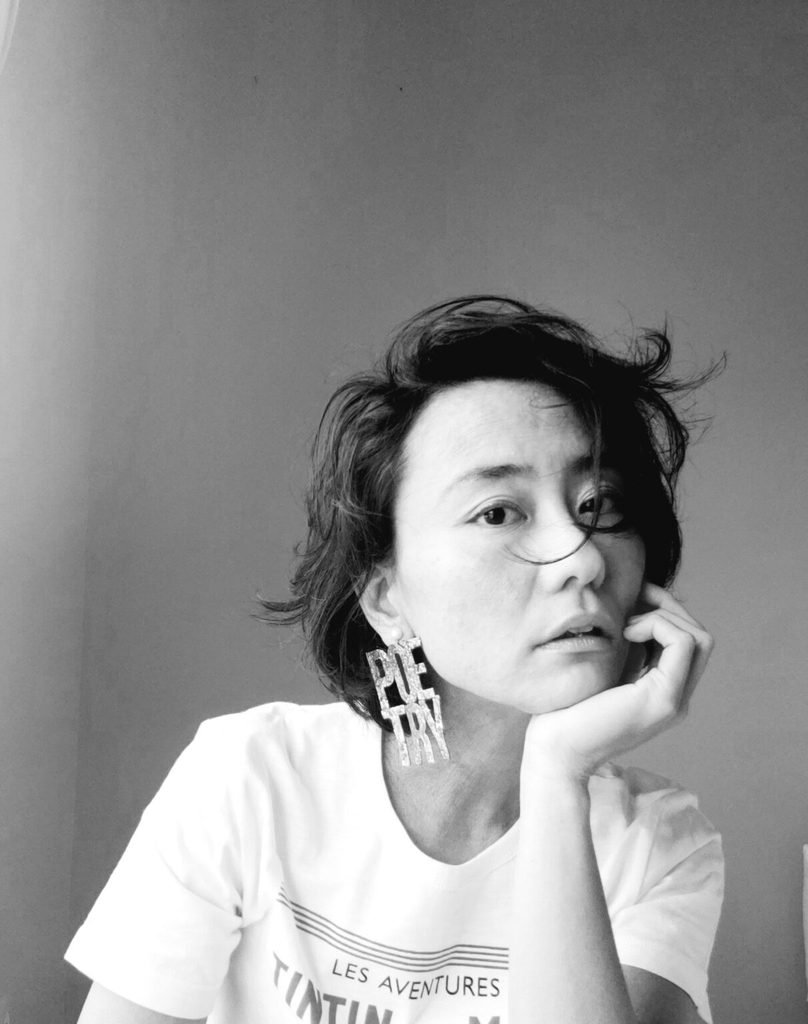
Naoko Fujimoto was born and raised in Nagoya, Japan. She is a poet and translator. She is the author of of Women (Tupelo Press 2026), Mother Said, I Want Your Pain (Bull City Press 2026), 09/09 (Toad Press 2024), We Face The Tremendous Meat On The Teppan (C&R Press 2022), and Glyph:Graphic Poetry=Trans. Sensory (Tupelo Press 2021). She is a RHINO Poetry editor.
