FEBRUARY INTERVIEW with ASA DRAKE
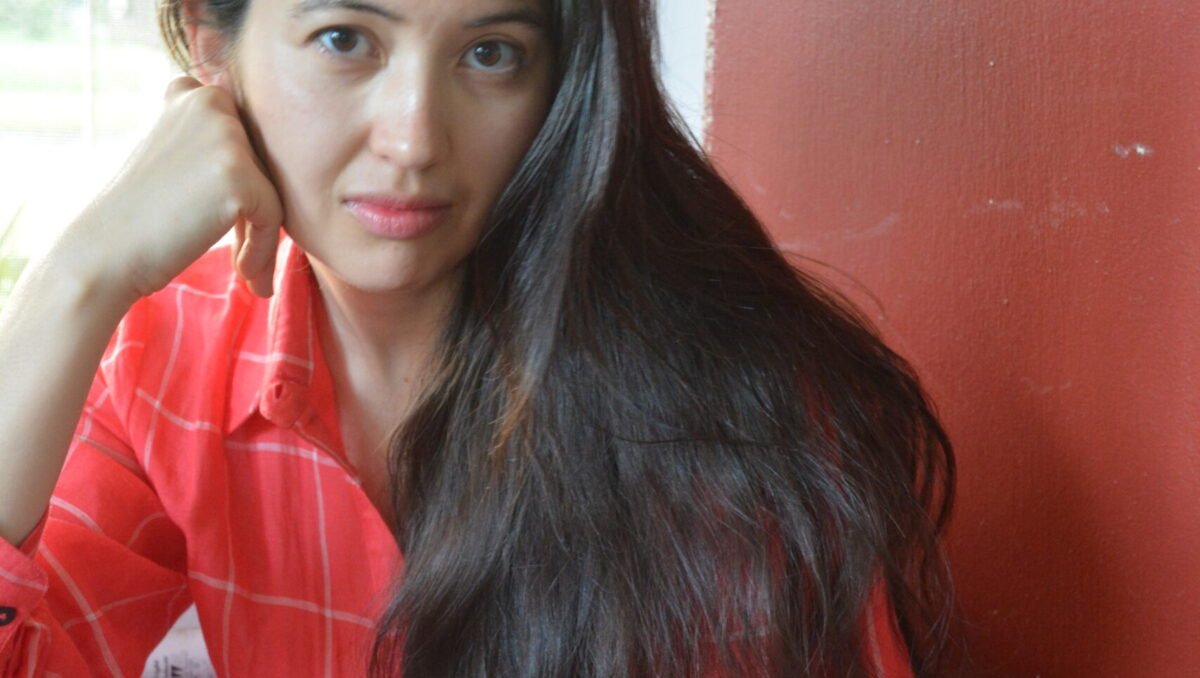
Perhaps it’s no surprise that the first of Asa Drake’s two debuts, Maybe the Body from Tin House, is flush with the fruits and flora of a flamboyant garden, given that she lives in rural Florida. Nor perhaps is it a surprise that the book is fecund with cleanly honed commentary of what it’s like to be a biracial woman of color—Filipina and white—in among this splendor. Sumptuous, lush, observant, Drake turns her perceptiveness back onto those who look towards her and her body with an occupying gaze, and in doing so, creates her own—flesh-blooded, flower-wrought—empire.
Asa Drake is interviewed by associate poetry editor Nicole W. Lee.
FWR: Congratulations on not only one, but two debut poetry collections! I want to begin with the epigraphs. There are two at the beginning of the book, one by Gina Osterloh, a Filipino American artist, and one by Walt Whitman. I think these capture the themes of the book perfectly. Osterloh’s comment about understanding camouflage not as a tactic of war, but as “a way in which the body can occupy an out-of-body space,” rings true for me, not just with regards to people of mixed ethnicities, but for people of color who need to adopt, let’s say, a semiotics of survival—to adopt for example, a voice, cultural references, or mannerisms to appear non-threatening to white society. The second epigraph speaks to the other themes of your book, such as companionship, either through family of origin or chosen family, as a garden. To me, the epigraphs perfectly set up the emotional axis of the book, that is, the nuances of camouflage as a biracial woman in America while embedded in the supportive community you’ve sown. How did you come across Osterloh’s meditation on concealment and occupation of “out-of-body space” and Whitman’s vision of kinship as garden, and how did they become in conversation with the poems in your book?
AD: I love the phrase you use, “a semiotics of survival,” because I often find that friends and I are sending each other little objects–signs and signals of our belonging in the world. I came across Gina Osterloh’s art because the poet Annie Wenstrup went to Osterloh’s exhibit at the Columbus Museum of Art. Annie and I both live in somewhat rural areas (maybe it’s better to say we live at the center of rural areas because we both live in cities–though cities that are much smaller than what others might call a city). When we travel, we try to share what we see. I actually still have the art book Annie sent me from that exhibit, Mirror Shadow Shape, which introduced me to Osterloh’s concept of the anti-portrait.
In Osterloh’s work, the body is always present, but there’s a different texture and framing to how we as the audience are able to approach. The prose sections within my book actually come from me trying to find a way to change the texture or framing of my approach to canonical writers in the United States after listening to one of Osterloh’s lectures. And the route I took quickly became difficult. I wanted to better understand how my aunt, Nena Gajudo Fernandez, as a poet who lives outside of the United States, read and translated Whitman. I should confess, I haven’t read a lot of Whitman. I originally thought this project would help me access his work through conversations with someone who’d deeply shaped my view of what it means to be a writer. Tita Nena published translations of Whitman and other American poets in the ’80s. When we talked about these translations, she told me that she’d lost her personal copies. So I tried to use interlibrary loan services. This was at a point when Florida libraries had begun to rely on a statewide (vs national) interlibrary loan system. Trying to reach a familial document, I was running into multiple infrastructure issues–from municipal flooding to concerns about the purpose and intent of ILL systems. (Should a public resource be used to support “academic” research?) In trying to seek out a particular translation of a poem about democracy and “the continent indissoluble,” I found a very fractured United States, far from the “Whitmanesque” democracy.
FWR: One thing that strikes me about this book is its use of repetition and difference. The garden in the book itself is influenced by the spiral of change created by the seasons — spring comes once a year, but it’s never the same spring. To me you express this idea most beautifully in the repetition of the poem title “To Someone Who’s Heard I Love You Too Many Times.” There are seven versions of this poem title throughout the book, some with the variation “To Someone Who Said I Love You Too Many Times.” Each of these poems builds on the previous ones, touching on themes as varied as being a biracial daughter, the speaker’s relationship with her partner, the three generations of women in the speaker’s family, politics in the Philippines, politics in the US. What interested you in using the same title (with variations) to link these poems throughout the book? Did you discover through this process, as the mother’s speaker wished for her, the “possibility of repetition”?
AD: So much of Maybe the Body is designed through failure–a failed crown of sonnets, a failed essay. But I found broken forms useful and reflective of an uncertain space I often consider home. Doesn’t every rupture create an ecotone? I found the ability to shift into prose, to say something plainly, essential to being able to move beyond a repeating story. I’ve often been warned that my writing is elliptical. The truth is I find it difficult to say anything at all. There are stories I can’t repeat and stories I will only repeat to certain audiences. So I allowed the forms I had started to write to be reshaped to hold those silences. I overlaid narratives I couldn’t complete with the details I found most useful to my sense of self. The final “I love you” sonnet–it’s filled with omitted language, omitted names, but I considered it a meaningful experiment. Even removing the stories I can’t share and the language I don’t know, there’s an emotional truth that I can still show to someone else.
FWR: It’s interesting to hear you say you were “warned” that your writing is elliptical. And yet to me the elliptical nature of the exploration of these topics allows each poem to throw off a different facet of the speaker’s experience—which of course, includes silence. Could you elaborate more on how the circular nature of your poems might reveal things that a linear telling wouldn’t be able to hold?
AD: When I was in elementary school, I had a very early encounter with Nietzsche’s “the eternal return of the same.” Someone told it to me as a parable? I can’t remember the reason, but it wasn’t a comfort. I thought of many ways to try and escape the proposition of reliving the same life (via faster cycles or longer ones). I remember thinking about how difficult, once introduced to the idea, it was to imagine a life without repetition. It haunted me. Maybe it’s a little cruel, but I hope to share that discomfort with the reader.
So many of the first stories we’re told are cycles—fairy tales, oral histories—and they’re full of repetition, recycling, transformation. I’m interested in how these stories allow for multiplicity—the daughter who is both the ward and caretaker of a tree, the boy who becomes a swan and then a boy again. Even death becomes a temporary or altered state of being. Maybe a linear telling might still reach the same conclusion, but I like that a circular route offers endless revision. And at the same time, the elliptical rejects closure.
FWR: Another structure that repeated throughout the book I particularly loved is the poems that I would call zuihitsus, or at least the poems that lent themselves more to a prose-like nature. I found these poems to contain some incredibly perspicacious lines — “I’ve yet to find a term of self-reference that does not equate to ornament,” “T calls my identity over pronounced, a preproduction / of women he does not know” and “The first time I saw my likeness / on television, the actress pretended / to be all-white. The second time, she wasn’t human at all” being just some of them. I found them particularly shrewd in the way they pointed to the Asian female body, and the way it’s consumed in the West, through a mixture of imperialism, patriarchy, and racism. Could you tell me more about your relationship to the intersection of Western mainstream beauty standards and Asian women, and how you felt about tackling these kinds of questions in the book?
AD: I love zuihitsus, but have always been hesitant to claim any of my attempts as accurate representations of the form. I also love the monostich and how it finds its way into forms like the zuihitsu. It lends an aphoristic quality that I really relish, especially because of the white space around a monostich, which offers rest and extended silence. And there are the more constellated versions of these poems like “Abundance” and “Apparently Monarchs Who Emerge Each Winter…”–these are shapes that I attempted because of your work and Jimin Seo’s advice. Both of your poetic practices made me a little braver in embracing caesura.
For me, something about this combination (of aphorism and silence) makes these long sporadic lines perfect for engaging with parental advice. I’m able to stick a thought on the page and then circle around it. I suppose in that way, it’s a form that allows me to keep going. Both of my parents are very beautiful. My father was a model in the ’70s and my mother was her town’s sweetheart. Beauty is something they both knew made their lives easier and as a result, it’s always been the thing they’ve most wished to pass on to me. Some of the ways they’ve stated this desire have resulted in language I turn over again and again. Sometimes to rehabilitate, sometimes to amend.
I don’t think either of them really understood how beauty for me might be different from either of their experiences–because of place but also because of hybridity.
Anne Anlin Cheng’s Ornamentalism better describes the social constructs that cause this feeling than I can. Cheng offers a vocabulary for Asian femininity under the white gaze and how racialized beauty synthesizes a particular experience at the crossroads of race and gender and labor. She offers a theoretical framework for why I feel my skin most in the workplace. There’s a history of unmaking Asian American personhood that’s deeply tied to clothing and beauty. So when I worked as a librarian, a very customer service focused field, even decisions like leaving my hair down or what color I choose to wear might result in me being perceived as more or less an object for gratification.
FWR: Speaking of family members, I also found the portrayals of the woman in this book deeply powerful to me. The speaker’s mother, the seeming carrier of culture and language for the speaker, is a large figure in this book, despite her not wanting the speaker to “repeat / her life.” This is in contrast to the grandmother, who is heavily involved in feminist Filipino politics, and the speaker’s great-aunt, who wishes to translate Whitman “to make a primer for revolution.” Could you talk a little about the different women in this book and their different subject positions and perspectives, and how that influenced the writing of these poems?
AD: When I was little, my mother and Nanay emphasized the importance of matrilinear names. I can easily reach for four generations of last names, to my great-grandmother’s mother. (But maybe my phrasing suggests, also, how I feel able to claim certain relations more than others.) I think the women in my family wanted me to have a sense of place beyond the United States. I used to go home every summer with Nanay and spend time with my cousins and great-aunts.
It was in the Philippines with Tita Nena and Uncle Egai that I first met living Filipino artists in diaspora. I remember Uncle Egai and Tita Nena taking me to a Filipino American comedian’s sold out show and realizing that what I have to say about myself could be of interest to other people. And it’s behind the register of another uncle’s sari-sari that Nanay and other relatives taught me about the history of American occupation, and how this history directly shaped the Philippines in economic terms–from martial law to overseas workers. (She also taught me to make change for customers in multiple languages.) So many of the braided forms in Maybe the Body try to preserve these histories and how they were told to me. There are other ways I could differentiate my grandmother and great aunts (four sisters altogether, including Nanay) which are more interesting (and more informative to my writing), but they’re all stories I can’t tell.
FWR: I happen to be privileged to know that you have a marvellous garden in Florida, along with a very cute bunny, named Bun! Speaking of rabbits, multiplication, reproduction, and procreation of the garden, animals, and of the female self are also overarching themes in this book. Intersecting with these are several significant tensions: a fear, perhaps, from white society about the reproduction of Asian bodies, the tragic shooting of the six Asian nail salon workers in Atlanta, and then the very violent rupture of the overturning of Roe v. Wade, and the resulting Florida abortion ban.
I really love that the book both celebrates and interrogates the qualities that are mostly assigned to women: tending to the body and its creations, the garden, and animals—the forms of caregiving so often dismissed in a patriarchal society. For the most part, the brutalities depicted— the shooting, the abortion ban—are instigated by straight men. How does this context shape the speaker’s engagement with care, fertility, and survival? And how do you see the book as a call for the feminine, the non-Western, the fertile, and, to return to the epigraph by Whitman, a queer or alternative sensibility in cultivating a garden of companionship?
AD: One of the first Whitman poems I was introduced to was “When Lilacs Last in the Dooryard Bloom’d.” I suspect that this has something to do with me growing up in the South and this being a poem strongly tied to the Civil War as an elegy for Abraham Lincoln. Whitman ties mourning to a season–it’s an emotion shaped and remembered by the sensorial though there’s also an effort to imply the universal (“Blossoms and branches green to coffins all I bring”).
Maybe it’s this sourness that makes me feel most a part of my family, which is full of stories about beautiful women who make beautiful things–poems, embroidery, gardens, businesses. In none of these stories are the women described as kind. (In one, a woman buys a necklace from an unscrupulous neighbor, gold link by gold link.) I’m interested in that family legacy of making–not as a nurturing impulse–but as an act of beauty, even an act of selfishness. Femininity-as-vanity is a cliche, but what if we didn’t punish it as a vice, what if vanity wasn’t indulgence but another kind of pursuit? I love that money is synonymous with women in my family. They were good at making it. (Everyone was good at spending it.) That gold chain is shorter today than when my relative acquired it. During martial law, she used it like currency, not unlike the “portable property” Wemmick praises in Great Expectations. It was a kind of vanity that fed us.
FWR: That’s interesting to hear you mention that the thing you struggle most with is the universal. I take it to mean you feel “sour” that women in your family haven’t been allowed to be their whole selves—not just beautiful, but also kind and, dare I say, vain and selfish. To allow themselves, to quote Whitman again, to “contain multitudes.” How do you feel writing this book has allowed you to interrogate all the complexities of your identity?
AD: I love the idea of containing multitudes, but I also love single essences—the possibility of inhabiting a single emotion feels like such a luxury. The women in my life have many roles, but I don’t want to hold them to any of those. I’d love for there to be time to only be sour. Being sour is self-indulgent. It’s corrosive and even a challenge. (I’m thinking specifically about how my uncle’s favorite food to force on tourists is fresh kamias.) Sour isn’t about pleasing someone. It’s not at all productive, which is something I worry a great deal about. Productivity is such a virtue, but for myself, for the people I love, I’d like to imagine what else might fill our hours.
FWR: This book was written over a long time, and in fact, as mentioned earlier, culminated in two debut books coming out this year! When did the writing of this book start for you, and how did it change over time? I’m also curious as to the process of writing two books at the same time, and at what point you realized you had two books. How did you decide which poems would go in which book?
AD: It’s funny that you mentioned spring earlier because the last poem added to the Maybe the Body, “Afternoon in the Cemetery,” was written across three different states, three different onsets of spring. I’d written it to bridge the two books–and the different formal choices in each (especially formatting choices regarding dialogue and borrowed language). When I realized the choices I made in one book couldn’t be applied retroactively to another, I left this apology and the promise of a different attempt in Beauty Talk (2024 Noemi Press Book Award winner). I had to acknowledge that as different experiments with different parameters, I couldn’t apply the same practices to both.
Maybe the Body, especially, is shaped by my librarianship. It’s a profession that thinks a great deal about catalogs and how we organize information. Of course, the categories we work with are imperfect, shaped by the biases and power structures that surround us. And yet, guiltily, I found them useful, especially in thinking about how a collection moves in terms of population, in terms of time and place. Maybe the Body took years to write, but in 2024, I started sorting through poems based on how they pointed toward different family archives.
I sometimes joke that I have a mother book and a father book, but at a more granular level I started separating poems based on how I am perceived. With whom am I in conversation? was a question I frequently asked myself when differentiating between the two books. I’m not sure if this will be obvious to the audience, but for me Maybe the Body is a collection where I try to deflect the white gaze. These are poems that imagine the possibility of safety. I’m writing toward others in the same ecotone and liminal space I consider home. In Beauty Talk, I gather all the poems which require confrontation–I allow myself to relish my own hostility–and question the use of it, especially as someone who when confronting the white gaze must acknowledge my partial relation–how I benefit and replicate it.
- Published in Featured Poetry, home, Interview