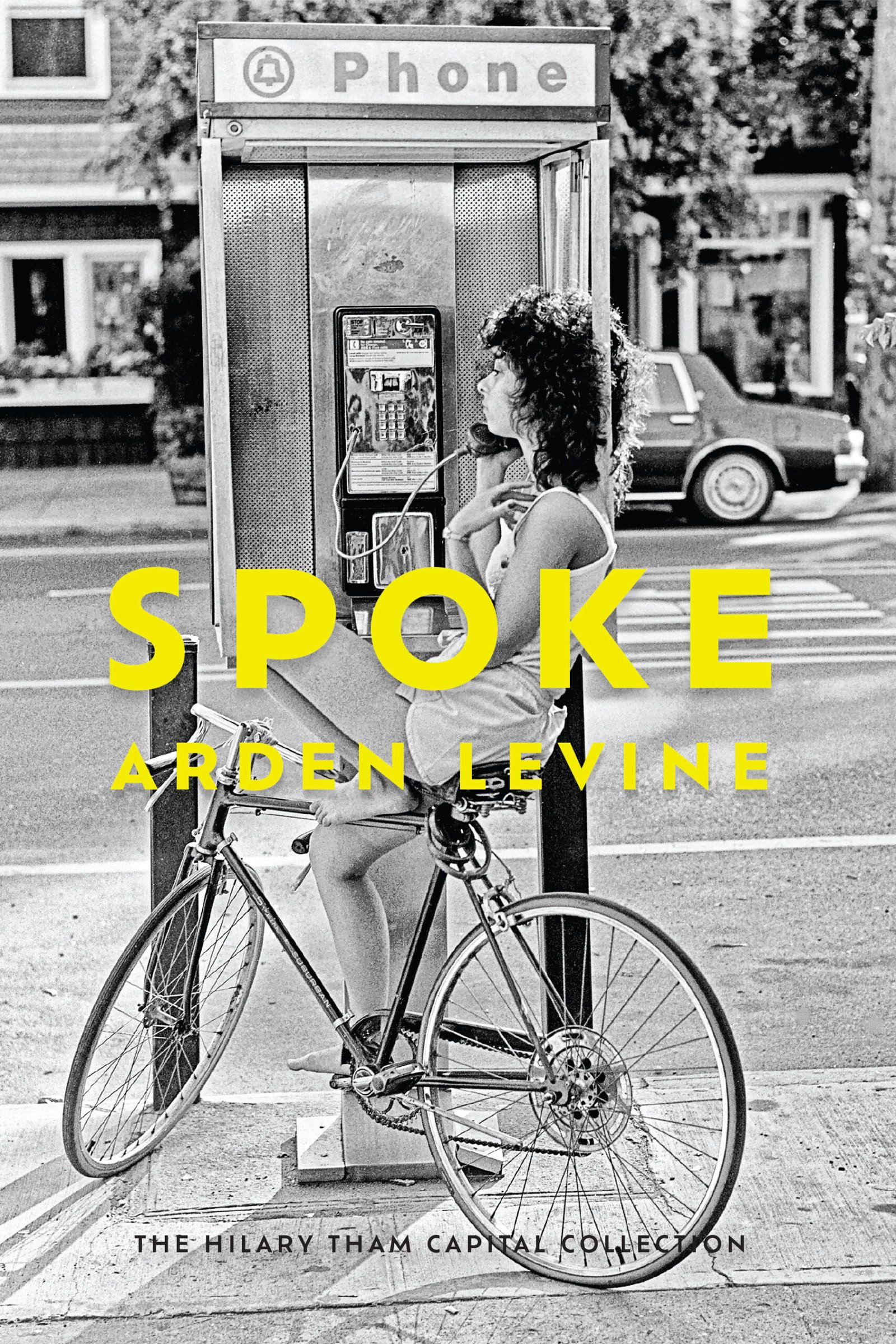
Until Arden Levine’s Spoke, we didn’t realize we’d actually been waiting for someone to reinvent the wheel. Yet here it is, with its clean lines and hard curves, each perfectly crafted poem a tensile strand of bodily sinew radiating from a hub of composed observation. At that hub, the life and early death of a complicated father (who is also a physician and a cyclist) and a woman spinning her stories: of accidents and harm, how and whether they return or resolve; of the gyrations toward affection and compassion (and the occasional skid-out); of the hard-pedaling past entropic detours; of how we arrive on our paths.
Arden is interviewed here by Carole Symer.
FWR: It’s rare for me to devour a collection of poems, cover to cover, savoring each poem, each line, sequentially. For years after reading Gregory Orr’s Poetry as Survival, I’ve been looking for the next collection that makes an art of addressing, treatment of, and transcendence of deep, primal pain. And then this, your debut full-length collection—a wheeling collage of masterfully crafted experimental poems reflecting the multitude of loves and griefs in us all. So, we begin with the craft of storytelling, how you walked and rode with the ghosts and rendered them as vivid, how you spoke to and through the dead and abandoned, how you delivered them through a full-of-life speaker.
AL: Gregory Orr actually offers a good first footing here. His poem “Beginning” concludes this way: “Now you begin. Because your boots / leave no marks on the hard earth, / you will make each journey many times.” In Spoke, the cycle (as machine, as metaphor) proved such a useful device because stories of injury and love can often be both high-velocity and non-linear; we may race to the end of the loop to discover it’s a loop. So, these poems tell a story of a woman’s journey not as beginning to end but beginning to re-beginning (on repeat), sometimes with a change of fortune as the cycle renews.
To wit, the poem literally titled “Fortune” contemplates a series of scenarios that could have occurred if a daughter’s fate had cleaved more tightly to a father’s; in the context of the poem (which sorta pops a modern wheelie on Carmina Burana), some of those macabre scenarios are still possible, but the reader recognizes that the daughter’s story can just as easily switch direction.
Finally answering your question then (or, er, circling around to it?), and I know you’ll appreciate this as a trained psychoanalyst: In order to tread the past with empathic attention, we necessarily ride along with those who live only in memory, especially when we are hoping to find turn-offs that change the memories, the people within them, or the direction they set for us. Which is why in Spoke, those who are gone may resurrect or recur (dead in this poem, alive in this later poem) as the woman treads the cycles seeking (and discovering) vectors to new eventualities. Frankly, I found it invigorating to converse through poetry with those I’ve lost: memories, even (especially?) bleak ones, are aesthetic and malleable. And for a writer, they have great opportunities for humor, reverence, and play, every one of which I snagged.
FWR: You render this concept of cycling the loop so thoroughly and tidily in “Prospect Park in 10 Speeds” – that feeling of wondering if what you just saw coming around the bend (of your mind, of a track) was real or imagined, a living being or a conjured one, the mind’s eye snapping open and shut in trying to recall or focus. A set of monostich-and-couplet stanzas in ten-part harmony, this poem shows how sequencing our snippets of remembrances can wrap through the streets of our cognition. Or how our mental shifting, gear to gear, invokes the multivariate versions of the father(s) and lover(s) we’ve known. Or how our shifting/multiple self-states keep yearning for that man, not that man. Turning memory into mythos, this zuihitsu-like poem does it for me. First the image is clear, then click, he’s gone and can’t be conjured up. Then click, a silhouette. Then click and only the body, foot and leg, of a self. Then click, he’s gone again, displaced by something more sensory and present.
AL: There are two things I’m particularly moved by in your reading of this poem.
First the clicks! Though I didn’t actually use that word in the poem, I realize that’s perhaps the very sound I was hoping to invoke: the click of the bike chain twirling, like the click of a camera shutter, that both captures and forecloses on the moment prior and moves us to the next one. I designed Spoke as a very sonic book; even some of the quieter poems have a lot of music and noise. So, if you’re hearing things rattling around in this poem, it’s done its job well, especially because it zips very fast down the page and, as you note, races across the mental landscape of the speaker; everything is going to shake loose. Also, as I’ve mentioned in a couple of other interviews (with COMP and with Under a Warm Green Linden), I’m a recovering photographer who still instinctively thinks in snapshots; the book invokes picture-making literally (see references to Richard Avedon) and more obliquely, such as in poems like this one that read like a stack of Polaroids.
Second, and segueing from your last question, this poem presents the cycle imagery most wholly. The interior drive in Prospect Park (in Brooklyn, New York) is an actual physical loop*, and in this poem, there is an actual physical bike cycling on that loop, there is a memory of an earlier bike and a man disassembling “it” (the bike or the memory?), there is an actual man on that physical loop that may be the man in the memory, there is the physical act of sprinting to catch the bike, and there is the act of sprinting through a riffled deck of recollections of characters (lost father, former partner[s]) to create something sequential or tangible enough to set coordinates to. This poem turns out to be a pretty good synecdoche for the whole book; most of Spoke leaves the reader a little at a remove from an absolute truth, a little spun around in time and space, and in so doing invites that reader to co-construct (or at least co-speculate on) the scene.
(*Also, and speaking of construction: My city planner career bona fides reveal themselves in Spoke; playgrounds, traffic circles, perimeters… the poems tend to be mapping something out.)
FWR: So many of your poems are so exquisitely compressed: nothing spared, nothing in excess. I’m struck repeatedly by how you pour large themes of grief and mortal beauty into these small-ish lineated receptacles; several are fewer than 50 total words. They cut deep, are so varied in form, yet fit so neatly on the page.
AL: I think my poems are good examples of exercises in extraction… like, in both senses of the word, e.g., removal, or making a really concentrated version of some botanical product.
FWR: Actually, there is a poem by the 20th Century Norwegian horticulturalist and poet Olav H. Hauge, “Years of Experience with Bows and Arrows,” in which he references that, in archery:
That black spot is highly annoying
until you finally grasp
that where your arrow stands quivering
is also the center of something.
That accuracy of aim on a narrow target feels relevant to your poems and poetic sensibility. As a poet mines her history for material, good poems also standing quivering as discrete art objects that the poet hopes will ping in her readers as well. I know this happened for me when reading Spoke.
What decisions did you have to make as you were writing and revising the bulk of these poems regarding size and shape so as to embody not just a poet’s true heart but with some kind of implicit aim perhaps that they will reach into a reader’s emotional experience (or grief, hope, delight)?
AL: Coming back to Gregory Orr: In a New York Times article about the devastating event that set the context for some of his own poem-making, he notes that “accidents happen… even the most ordinary among us live in a world of risk and randomness that we don’t control.” Another way of saying: Everyone has experienced catastrophe, or has feared it, or both.
The poems in Spoke lean into the inevitability of harm: the car will crash, the child will fall, the gun will fire, the tooth will shatter, the rib will puncture the lung, a shard of glass will sever the lifeline, the illness will leave you lonely, the beloved will leave you lonely, the skin will break or the heart will. By doing so, they activate the beacon on the universal distress transmitter: We are all living in the condition of risk. That’s the black dot. The specifics matter less than the conceit; a reader has an invitation into each of these poems through the common experience of crisis and the question of whether and how the resulting damage was (or will be) sustained or overcome.
FWR: “Interlude: At My Therapist” gives a great example of this distilled catastrophe/catharsis. The entire poem is comprised of seven words repeated in five different configurations; without punctuation or capitalization, they first dangle in mid-air as if we are staring up at a mobile with the patient from her horizontal position on the proverbial analytic couch. Yet by the end, the words transform from compulsive repetition to magical invocation, and the speaker (and reader) have experienced intrapsychic change created less so by treatment than by time.
AL: Exactly. (And beautifully observed; thank you.) I engineered many of these poems as safe chambers, compartments for the exploration of grief, for primal reactions to multivariate disasters. In most of the poems, the speaker gets her emotional decanting over the course of a single exhale (or, often, a peal of laughter); ideally, so does the reader.
FWR: If the poems are tonics, they’re salving a host of maladies. The prose poem “Dis-ease,” in which the speaker examines the content of her father’s medical journals, evokes Kimiko Hahn for me, her entire collection, Foreign Bodies. Or maybe Laurie Anderson’s Big Science album. I’ll quote some of it here: “My father once pointed out delicate maggots, like freshwater pearls, debriding the open oyster of a kneecap. They glinted from within the putrescence. They were welcomed onto diseased flesh, tiny clerics removing ailments and leaving intact the vital.” Who was your tutelary spirit for some of your marvelous, deep dark science-honoring poems?
AL: Actual medical journals, anatomy books, proceedings of societies of biologists, the Diagnostic and Statistical Manual, my deceased father’s scads of notes, staring at birds a lot. Because the father in Spoke is a doctor, the speaker’s early understandings of how a body or a mind can malfunction arrive sometimes from authoritative sources and sometimes from her own observations. In the poem that you mention, she becomes both troubled and intrigued as she connects images of diseased and injured animals to the bizarre, fanciful animals in children’s stories and to the experiences of her own young body’s fallibility.
Spoke moves around a lot within a corpus of terms: harm, injury, trauma, hurt, pain, illness… these are synonym-ish words but also have distinct individual meanings, especially when viewed as mental vs. physical and individual vs. relational. Also, various poems in Spoke treat the mortal body like a machine, so the bicycle becomes an analog and appendage, and the bike repair manuals and technical jargon become books of spells and teaching aides. And in a way, the reader (and the speaker) “earn” those more erotic and confident “body poems” near the end of the book by grappling with clinical bodily realities in the earlier poems.
FWR: I feel like we’ve discussed the book’s heart so much, but this book has a killer body too! Pop music! Classical artworks! Wacky ‘80s/’90s cultural vibes, city beaches and teen hormones, the weirdness of approaching middle-age! Not to mention fascinating page-use devices: a steady rainfall of brackets and parentheses, a hip-shifting bounce from left to right margin justification. But what really smacked my gob was the humor… the amount, the timing, the whoa-so-wrong-but-oh-so-right-ness. Like, “[Hospital Guests]” and “[Funeral Guests]” are poems that one wouldn’t expect to be great comic bits based on the titles, but there you are: The inane, wacky questions of well-meaning people, and the super-cheeky replies of the beleaguered victims and survivors. Even when we do a bad job showing up for each other, a poem can show up for the readers and give them a good time; yours certainly do that.
AL: And because we were just talking about compartment-making and tutelary spirits: I love graphic novels, how they relay histories and revelations with wit and sashay in little apartment-sized squares. (This appreciation might be the urban planner / housing advocate part of me talking again.) Many bildungsroman comics were source material for Spoke: Fun Home by Alison Bechdel, Maus by Art Spiegelman, Persepolis by the incomparable late Marjane Satrapi… all of them address the strange contours of family dynamics and the yearning for an understanding of what home (in a changing geography, in a changing body) represent. But their especial power is in how they drop the readers right into the absurdity and let them crack up about it.
In Fun Home especially, another book that resurrects a father, Bechdel says “if my father was Icarus, he was also Daedalus, that skillful artificer, that mad scientist…” It’s a morbidly cryptic (and foreshadowing) remark, yet the text appears over panels illustrating her father’s obsession with lively home décor (in a house that doubles as a funeral home, by the way, but is also a fine-lookin’ stack of bricks). That juxtaposition of horror and humor, and fusion of home and human, achieves so much narrative combustion in so few pen strokes it can blow a fuse.
So, back to Spoke… In the two poems you mention, the speaker is reacting to people reacting to her family’s condition of distress right as she has absolutely depleted her surplus of fucks-to-give and is instead offering some heavily-armed snaps. (Example: “Handling [it], exactly. My family / does catastrophe like kettle bells.”) Levity, misdirection, compression, and surprise… Ultimately, all artworks that draw on personal experiences are a form of persona work, a character sketch in a wee box, and one of my favorite inking tools when writing this collection was depicting the speaker of the poems as cleverer or cheekier than I could often be in the moment. Indeed, when one of the final readers for Spoke (Elizabeth T. Gray Jr. an extraordinary poet and a recent finalist for the PEN Poetry in Translation Award) read these two poems, she said “so this girl is kind of an ace, huh?”
It put me in mind of another brilliant (but lesser-known) graphic novel series called Zen Comics (created by Ioanna Salajan) in which an old monk offers his tender disciple regular stunning whacks of enlightenment. During one interlude between stories, there is a page that reads “Nothing is left for you at this moment but to laugh.” I might even edit it to “Nothing is right for you at this moment but to laugh.” Which kinda reads like the feel-good bookend to the Gregory Orr poem excerpt at the front of this interview: if we’re on this self-repeating journey, and especially if we’re often traveling in dark conditions, it’d better be a helluva trip.
FWR: And in a collection where direction is almost its own character, it seems somehow fitting to end in the middle: In the center of Spoke (which is to say, literally, in the exact midpoint of the collection but also, conceptually, holding constant), there are two back-to-back poems: The first is “Becalm,” which, as a verb, describes the condition of a sailing vessel left motionless due to lack of wind. But it is also an instruction to the reader, or perhaps a subliminal mantra conveyed by the reader to herself in the center of chaos. (And remarkably, though this poem describes a water vessel, you still sneak in a bicycle tire with that three-word line “flat, the air.”) The second is (aptly titled) “Middle,” in which the speaker finds herself in the nexus of her vexations about maiming spiders and modifying tattoos… experiencing, perhaps, the relief of tiny domestic dilemmas amid crushing calamities. Do you consider these poems as the steady hub from which the other poems radiate?
AL: Yes. Or rather, it’s one of them, a little intermezzo where the book and reader get to lean back and coast. As you mentioned earlier, the poems in Spoke often bank hard left to right on the page—they’re holding their balance at different speeds and against different currents. That physicality of torque and division shows up not just in the poems’ forms but in their content as well: the split apples and sliced strawberries, the two gables of a roof and two surfaces of a slamming door, the morning that undermines or affirms the night, the humans we cleave to or cleave from. And by invoking binary alignment and dominant handedness, I’m also tossing back-and-forth the question of the sinister and the dextral—what remains is what’s left, what’s resolved is what’s right, but most of what exists (for the book, its speaker, the thing called life) is in-between. May the center hold.