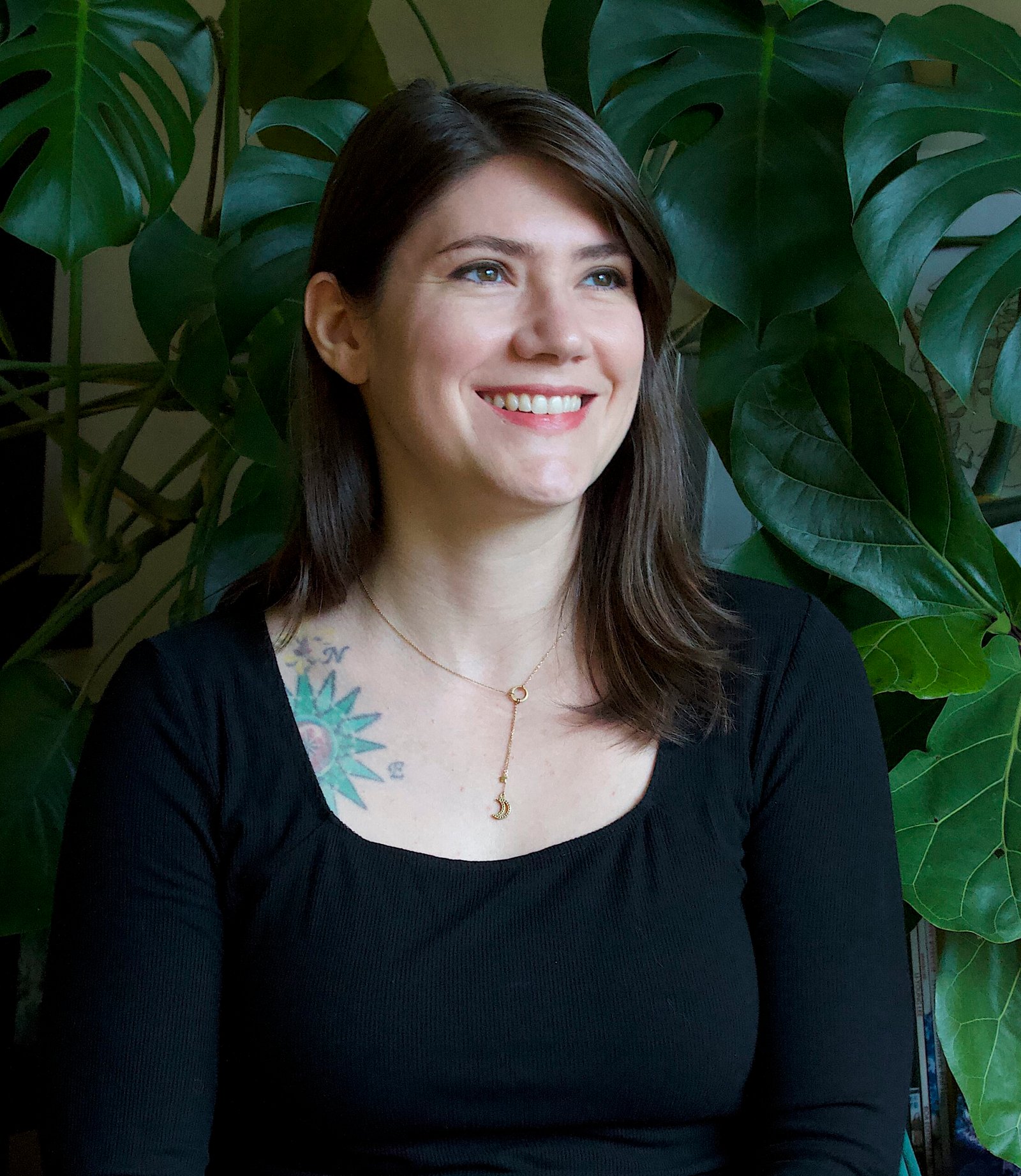
Arielle Hebert and I are approximately 7, 100 miles apart from one another when we hop on Zoom to talk about her debut collection of poems, Bottom Feeders – neither of us in the places we grew up, though that’s exactly what Bottom Feeders is all about. Hebert’s debut is a gutsy, sultry collection, set in a vividly conjured late-aughts Florida, covering everything from the opioid epidemic and queer girlhood, to how one is haunted by one’s home of origin, and, as Hebert says near the end of our conversation, “…loving home, missing home, letting home be the complicated creature it wants to be, and letting myself be that complicated creature, too.” Bottom Feeders is out June 16 from Black Lawrence Press.
Arielle Hebert is interviewed by E Ce Miller.
Four Way Review (FWR): One of my great obsessions—and Bottom Feeders speaks to this so well—is the idea of home, particularly leaving home, what it means to be from a place; this grip that home can have on us.
Arielle Hebert (AH): Definitely a shared obsession. I don’t know if it’s because I’ve left homes and have grieved them… [It’s] a home wound. I feel like people have a mother wound and a father wound, and then there’s this home wound.
FWR: So, maybe we can start by talking about Florida, particularly Florida as a character. I feel like Florida stories are their own thing in a way that not all place-stories are. In the Florida of this collection, there’s something humid and subdued, coupled with something that just crackled really electric for me. In the poem “Elegy for Florida”, Florida is literally personified [as] a young woman. Can you talk about how Florida exists as both a place and a person in this collection and what made you want to write this place in this way?
AH: I’ve always felt like place has character. [The poet] Joy Priest has a book called Horsepower, and in [it] she has an elegy for Kentucky. I don’t think they’re companion poems, but I was inspired by her. The obsession I have with primal landscapes and with leaving home and finding home is similar to how I feel about leaving family and finding family or chosen family. When I left Florida, it felt like grieving a personal relationship. It’s very easy for me to think of Florida as this whole complicated, complex, nuanced person. There are things I love about it, things that I wish weren’t true, [wish] were different.
In “Elegy for Florida,” I was also certainly writing about the relationship in the book.
It’s an elegy for Florida, but the girlfriend character in the book is also a bit elegized. That was not a literal death, but still a parting that required grieving in such a deep way.
It’s a poem that helped me heal a little, not only in my celebration of Florida, but also in the celebration of that relationship I was grieving.
The [collection’s] magical elements and circus theme also appear in that poem. There’s a bit of entertainment, bright costumes, and showing off, and I think those things are all very Florida, but also very much in [the girlfriend’s] character as well.
FWR: I also want to ask you about place—specifically, the ecology of place—and addiction in the collection. There’s this specter of hurricanes in Bottom Feeders running alongside this specter of addiction. In the poem “Hurricane Blues,” you write, “We treaded grief like water, / missed hurricanes in the off season / when chaos ebbed enough / for us to see clearly, all the damage…” which strikes me as equally true of both the ebb and flow of natural disasters and the ebb and flow of addiction and sobriety. I’m curious how you see ecology (natural disasters) and addiction relating to one another?
AH: I feel very close to the natural world. So much of [how I love a place] is in the flora, the fauna, the landscape. Florida has this very unique weather, including hurricane season. “Hurricane Blues” started out as a poem about a literal hurricane and then took on a more metaphorical meaning as I worked through it. There is almost an addiction to chaos, this thriving on chaos [described in Bottom Feeders], and I think hurricane season is a perfect metaphor for that.
I certainly was holding on to that chaotic weather of addiction as well, when I was writing: the ebb and flow of hurricanes, storms that we weather, how we weather those things as Floridians and as young people. It was a universal experience: everyone I knew in Florida had been through hurricanes, had damage and wounds to heal from, whether it was their homes, or animals, or family members.
FWR: The poem “Needlefish,” too, seems very much to echo the line in the poem “Magician’s Assistant” about the girlfriend’s bouquet of needles.
AH: “Needlefish” is another poem that, if you read it without the context of the book, could totally just be about a fish. A needlefish is so unique to Florida—such a beautiful creature, and yet it’s kind of alien-looking. They’re blue, you can see their bones through their skin. There’s a surreality to the creature that I think really captures the surreality of addiction. Within that larger context of addiction and opioid use, the abuse of prescription pills turned into using needles and shooting up, it just became a metaphor too ripe to not pick.
“There is a fish / in Florida / shaped like / a needle, / spear of bright / blue-green bones, / finetooth jade comb / visible beneath / iridescent scales…”
“Needlefish,” Arielle Hebert
FWR: I’m curious about your process, because you’ve described starting a poem with the literal and writing towards the metaphorical, which I think is really interesting and also maybe a metaphor for the healing process, as well?
AH: It definitely varies. A lot of the time, I start with memory and memory’s attachment to things, whether it’s a concrete subject or a physical object, something from nature, or objects from my life. I start by delving into memory, and that often turns into storytelling or “metaphorizing.” It does cascade into this larger meaning.
But I owe it to the poems. I owe it to the art. I feel like it’s less me and more what the poem wants to be and say.
FWR: I’d love to talk about the poem “Trap Doors.” I had such an embodied experience of reading it, and it really complicated language for me in a way that I find so interesting. In the poem, drugs are doors, they’re exits, they’re secret passages and thresholds—all words that invoke magic and play and illusion, but ultimately take on a really ominous tone, in the context of addiction. I think “Magician’s Assistant” is another poem that examines the parallels between magic and illusion and addiction.
AH: Sarasota is a circus town. John Ringling had his winter quarters there and built the John and Mable Ringling Museum. The circus is very alive and very well in Sarasota, and it kind of bleeds across Florida. I went to Florida State University in Tallahassee, and they also have a circus program. There’s a tent on campus year-round; you get college credit for circus courses. When I started writing the circus imagery, “Trap Doors” existed under a different title. I often look at the table of contents in a book—for me, that’s almost like reading the first poem in the book. As I got to that poem, I was thinking about doors, and portals, and thresholds.
It seemed a ripe metaphor; once you cross over a threshold, you often can’t go back. That is exactly what the opioid crisis created: these doors. Once you crossed these boundaries, maybe you could cross back, but it was going to be really, really difficult.
So, “Trap Doors” became the title.
“Magician’s Assistant” also had a different title at first, and it was a little more heavy-handed, I’ll say. I had written a series of “portraits of addiction.” I felt like those portraits were getting in the way of letting the [portrayed] just exist on its own.
I am not someone who starts with a title often. It’s one of the last pieces that fall into place for me. “Magician’s Assistant” and “Trap Doors” were both poems that, once the title changed, it felt like: this is done now, and I’m happy with it.
FWR: You said, “Sometimes you cross a threshold you can’t cross back.” That resonates so strongly with me, and I think it really leads into what I want to ask you about the poem “Dying Young in Florida,” especially the lines: “I’m older now, but going home still feels like / visiting a grave, and now I realize I mean / my grave…”
This strikes me as intensely true for a lot of people regarding the experience of going home—not just someone who has the history of profound loss that is described in this collection. This idea that returning home feels like visiting a grave works on multiple levels: there’s the literal loss—literal death—but I also wonder if there’s this sort of “death of who we become when we’re away” for a lot of people who return home?
AH: I remember writing the lines, “I’m older now, but going home still feels like / visiting a grave,” and then the next line dawned on me, and instead of writing around that realization, I put it in the poem.
I do feel like my past selves are folks that I’ve buried and grieved, in a way, along with the loss of home.
I feel like I lost former selves there. There’s another poem in the book about forgiving myself and apologizing to my past self. That was also one that was very healing to write, and that, as the process of writing the poem progressed, kind of became a literal loss, a death. You can’t step back into your old selves. They don’t fit anymore. With the thresholds you cross over, you choose your outgrowth. You’re never really going to be able to inhabit those same spaces. And for me personally, I can say thank goodness.
FWR: Right? That’s a relief!
AH: I feel like when I left home, when I left Florida, I was leaving a part of myself behind there. It’s hard to go back there and visit that old self or see pieces of her rear her head in the mirror. It’s a little bit haunted, a bit of a ghost of myself there.
FWR: Claudia Cortese, author of Wasp Queen, described Bottom Feeders as “a pop-poem singing the praises and tragedies of queer girlhood.” Yet, the collection doesn’t strike me as a strictly chronological arrangement or linear journey. There’s something sort of kaleidoscopic about how time, and even the ages of the girls in this collection, function in the arrangement of these poems. I think about the first line of the poem “For Not Letting Go,” which reads: “I begin again / the ceremony of searching…” In a way, it feels like the arrangement mirrors the content: it’s a spiral or a coil, rather than a line. Can you talk about how you arranged this collection and what the arrangement says about the ways one can experience time?
AH: Kaleidoscopic. That’s how time feels to me, especially when thinking about home, and Florida, and our young lives during the opioid epidemic—all the experiences in the book. Time is not a straight line. I think when I first started writing, I was very tempted to arrange these poems chronologically. I’m very lucky I have great mentors. One of my mentors, [the poet] Eduardo C. Corral, [said] “This is not a novel, and even novels don’t have to be chronological. It’s okay to insert yourself as present-day.” I think once I heard that, it clicked with my own experience of time and grief.
My partner and I have both had very heavy grievings in our lives, and there’s a metaphor that comes up a lot between us: the ball-in-the-box. Grief—the ball inside the box—might get smaller, it might ping off of the edges less often, but every time it does, it feels fresh, it feels new, it feels as powerful as grief did when it first came to you. It’s that cyclical, circular aspect of time. I’m also somebody who can’t ever think about a situation in my life just once. Every time I return to a memory, or a story, or an interaction, I learn something new from it, or I see it in a different way, and that was the experience of writing the book. Each time, I returned to this world and to these ghosts of former selves.
FWR: Nearly this entire collection is comprised of lineated poems, except for “The Kind of People,” a prose poem, and “Phantasmagoria,” which struck me as more of a personal essay than anything else. What inspired you to shift form, and what do you think is the relationship between these two pieces and the lineated poems in this collection?
AH: I do not consider myself a very formal poet. I write mostly in free verse. There might be couplets or tercets or different ways of playing with the page, but for the most part, I don’t write in form a lot. “Phantasmagoria” came out of an exercise in grad school, where we were tasked to do an imitation. I was reading Maggie Nelson’s Bluets [which] is written in small prose blocks, and there’s a blurring of genre in that book that I love so much. She’s such a poetic writer, but it was also a personal essay, it was a grieving. There’s a lot of research braided into that book as well. So, when I sat down to write an imitation, I did a lot of research and [it] started to function like a sonnet crown, in which each section of “Phantasmagoria” braids into the next one. Even though they’re these disparate pieces, it felt very freeing to incorporate research and rely a little bit more on the sentence. It was a lot of fun. Very early on, it felt like it needed to be pretty much smack in the middle, kind of like a hinge or a fulcrum. It provides a little bit of a breath. There certainly are heavy pieces to that poem, but I think the research and the historical context and the weirdness of some of those stanzas provide an opportunity to step back. That’s how it worked for me writing it, too. It was a way to step outside of the world that I was drowning in and create a breath for myself and for the reader.
“The Kind of People” is a little bit different, even though it is one big block of text. When I read it out loud, it feels like one breath, one sentence, one big gasp or sigh. It’s a headlong fall.
FWR: Reading the poem “A Little More Time” made me really aware of the way pronouns are used in Bottom Feeders—I was suddenly very conscious of voice in that poem, and it made me want to go back and sort of map the pronouns in the collection. In doing so, I realized you’re doing something really interesting with “I”, “you”, and especially “her.” “You” is, at various points, both the narrator and the narrator’s friend. “Her” is the narrator, the narrator’s friend, and also Florida. I’m wondering whether this was a conscious amalgamation and what it says about the relationship between the two girls, as well as about their relationship to a distinct place.
AH: When I first started writing these poems, they were all in second person. Instead of using “she” or “her”, they were all addressed to the speaker’s girlfriend. That came with a couple of issues. One, I feel like I was using the non-gendered “you” as a shield. As a young queer person, it was a way to not disclose my queerness. If I weren’t using the pronoun “she”, someone could read whatever gender they wanted into the poem. That shield was necessary for a long time. And then it ended up being a hindrance. The decision to change a lot of those “yous” to “she” and “her” dovetailed with my decision to put the word queer in my bio, which I feel very privileged to be in a place in my life where I feel safe enough to do that. It felt important to claim that identity publicly instead of shying away from it. Then there was no gray area. Folks had to read it as queer poems and queer love.
Again, Eduardo [C. Corral], let’s snap for Eduardo. He responded to an early copy of this manuscript: it’s beautiful, it’s a love letter, it doesn’t have to only be about her. This is about me, and Florida, and our feral girl gang; these girls that we were, but also Florida as a person, as a character, as a woman—a complicated woman.
When we get to “Elegy for Florida,” that’s where I was really trying to say that yes, this is about the speaker’s girlfriend. It also freed me to embrace my queerness publicly. I’m married to a man, and so often when folks meet me, there’s an assumption about my sexuality. Again, it just felt like a privilege to be able to claim that queerness and embrace it. I feel like I was doing young me justice by saying: we’re in a place now where we can say this and say it safely and own it.